How Smart Hotel Energy Saving Systems Reduce Operational Costs
Learn how smart hotel energy saving systems reduce costs through IoT, automation, and real-time energy management.

The Growing Energy Challenge in Hotels
Energy costs have become one of the most significant operational expenses in the hospitality industry. From HVAC systems running continuously to lighting and appliances left on in unoccupied rooms, inefficiencies are widespread.
As Philip Wolfe, former President of the Energy and Environment Alliance (EEA), pointed out:
“Energy is typically the second-highest operating cost in hotels, and the largest controllable expense.”
This means even small improvements in efficiency can translate into substantial cost savings. The question is no longer whether hotels should optimize energy usage—but how to do it effectively and sustainably.
What Is a Smart Hotel Energy Saving System?
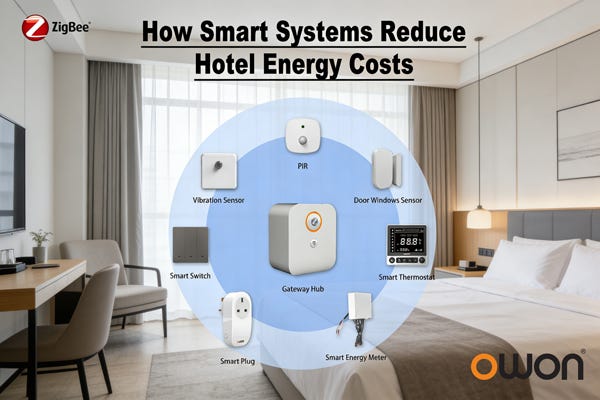
A smart hotel energy saving system is an IoT-based solution designed to monitor, control, and optimize energy consumption across hotel operations.
Instead of isolated systems or manual control, it integrates multiple components into one unified platform, including:
IoT gateway (central control hub)
Occupancy and environmental sensors
HVAC control systems (e.g., fan coil thermostats)
Smart lighting and power control
Energy monitoring devices
These systems enable real-time, automated decision-making—reducing waste without sacrificing guest comfort.
Where Hotels Waste the Most Energy
Before implementing a solution, it’s important to understand where inefficiencies typically occur.
1. Empty Rooms Still Consuming Energy
Lighting, HVAC, and appliances often remain active even when rooms are unoccupied.
2. Inefficient HVAC Operation
Temperature settings are rarely optimized based on occupancy or real-time conditions, leading to excessive energy use.
3. Lack of Energy Visibility
Without real-time monitoring, it is difficult to identify which systems or areas consume the most energy.
4. Manual and Fragmented Control
Disconnected systems and reliance on staff intervention create inconsistencies and inefficiencies.
Without automation, energy waste is not the exception—it is the default.
How Smart Systems Reduce Hotel Energy Costs
Smart systems address these challenges through automation, data, and integration.
1. Occupancy-Based Automation
Using occupancy sensors, the system can:
Automatically turn off lighting and HVAC when rooms are empty
Restore settings when guests return
This is one of the most effective ways to eliminate unnecessary energy consumption.
2. Intelligent HVAC Control
Smart thermostats dynamically adjust temperature based on:
Occupancy status
Time schedules
Environmental conditions
This prevents overcooling or overheating, significantly improving energy efficiency.
3. Real-Time Energy Monitoring
Energy meters and centralized dashboards provide visibility into consumption patterns.
As W. Edwards Deming famously said:
“You can’t manage what you don’t measure.”
By making energy usage measurable, hotels can identify inefficiencies and optimize operations based on data.
4. Automated Scheduling
Systems can operate based on predefined rules:
Public areas adjust energy usage during off-peak hours
Equipment shuts down when not needed
This reduces reliance on manual control.
5. System Integration
Integration with PMS and other hotel systems enables:
Room-status-based automation
Centralized control across multiple properties
Why IoT-Based Systems Outperform Traditional BMS
Traditional wired BMS systems are often expensive, rigid, and difficult to deploy—especially in retrofit projects.
Modern IoT-based systems offer clear advantages:
Lower Installation Cost
Wireless technologies eliminate complex wiring, reducing both labor and material costs.
Faster Deployment
Installation can be completed significantly faster, minimizing disruption to hotel operations.
Greater Scalability
New devices and rooms can be added without major infrastructure changes.
Open Integration (MQTT / API)
Modern systems support flexible integration with third-party platforms, avoiding vendor lock-in.
Reliable Offline Operation
Even without internet connectivity:
Devices continue functioning
Automation logic remains active
As Bernard Marr explains:
“The real value of IoT is not in the devices, but in the data and the insights they generate.”
This is why modern hotel energy systems focus on data-driven automation rather than isolated device control.
Real-World Example: Smart Energy Optimization in a Hotel Project
Project Challenge
A hotel needed to replace a traditional wired BMS that was:
Expensive to install
Difficult to scale
Limited in integration capabilities
The goal was to implement a more flexible, cost-effective system that could:
Reduce energy consumption
Enable faster deployment
Support third-party integration
Maintain reliable operation even when offline
Solution Approach
The project adopted a wireless IoT-based architecture:
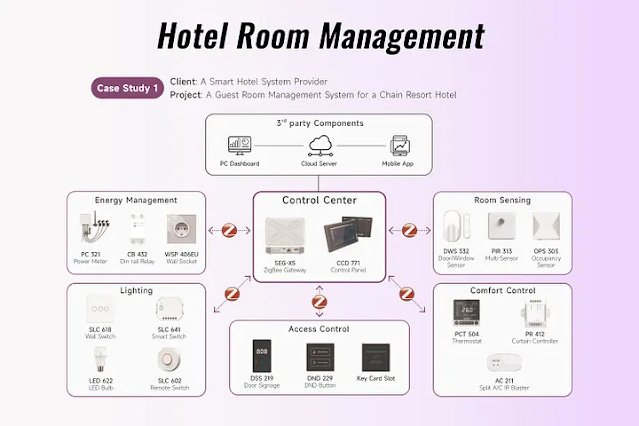
IoT Gateway with Zigbee Connectivity
Aggregates all smart devices
Provides device-level MQTT APIs
Supports WiFi, Ethernet, and 4G connectivity
Offline-Capable Automation
Devices continue operating without server connection
Supports local interaction between devices
Full Device Ecosystem
Fan coil thermostats
Smart switches and relays
Occupancy and environmental sensors
Energy meters
Curtain control modules
Customization and Integration
Tailored devices for project-specific needs
Traditional hardware upgraded with smart modules
Integration into DND panels and door signage
Android Touchscreen Control Panels
Centralized control for high-end rooms
Outcome
After implementation, the hotel achieved measurable improvements:
Energy consumption reduced by 18%–25% across guest rooms
HVAC energy usage decreased by approximately 20%
Installation time reduced by around 30% compared to wired systems
Maintenance costs lowered by 15%–20% due to centralized management
These results align with typical industry benchmarks for IoT-based hotel energy optimization projects.
Additional Benefits Beyond Energy Savings
In addition to cost reduction, smart systems provide:
Improved guest comfort through optimized climate control
Extended equipment lifespan
Support for sustainability and ESG initiatives
Increased operational efficiency
Is a Smart Hotel Energy Saving System Worth It?
Smart energy systems are particularly valuable for:
Medium to large hotel properties
Retrofit projects seeking cost-effective upgrades
Operators focused on long-term ROI
For smaller properties, simpler solutions may be sufficient, but scalability should always be considered.
Conclusion
Reducing hotel energy costs is no longer about cutting usage—it’s about managing energy intelligently.
Smart hotel energy saving systems transform energy management into an automated, data-driven process that improves efficiency without compromising guest experience.
As energy costs continue to rise, adopting smart systems is becoming not just an advantage, but a necessity for modern hospitality operations.